Editing Is Not Dead: Opus 5.5, AI Automation and the Death of Creativity
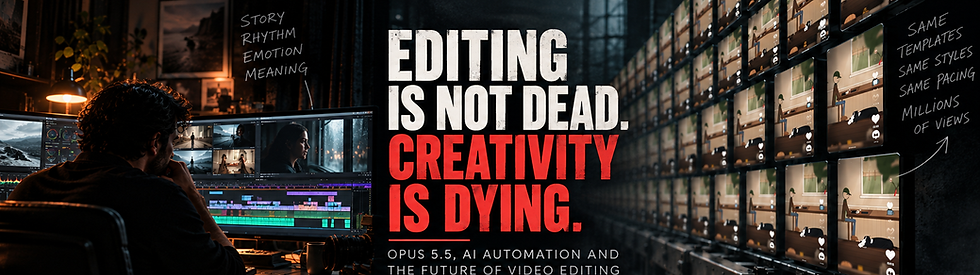
Artificial intelligence should expand the boundaries of filmmaking, not turn creativity into an automated production line. The growing claim that AI has made video editing obsolete confuses the ability to produce content with the ability to tell a story.
Opus 5.5, Viral Views, and the Illusion That Editing Is Dead
An X discussion about Opus 5.5 and a claim of 23.4 million views across five videos illustrates the problem. Even if the engagement figure is accurate, it does not establish that editing as a creative discipline is dead. Audience reach is a distribution metric, not a measurement of cinematic imagination. The figures and the extent of AI involvement should be understood as claims made in the discussion, not independently verified findings.
My original response on X:
The point of introducing AI into editing was to assist editors, save time, and open creative possibilities—not to replace every decision with an automated template. Yet thousands of videos increasingly share the same pacing, transitions, visual language, and structure. Editing is not dead. What is threatened is the incentive to be original.
Automation Is a Tool, Not a Creative Vision
Automating subtitles, organizing footage, preparing rough assemblies, masking, cleaning dialogue, or generating visual experiments can free an editor to spend more time on rhythm, character, and meaning. These are meaningful advances. But saving time on the mechanics of production is different from handing over the purpose of the work.
A machine can reproduce a familiar style at scale. The more difficult task is deciding why a cut belongs where it does, why a moment needs silence, why an image should linger, or when an expected transition should never happen.
A Claude Opus 5.5 Workflow for Video
What would a useful Claude Opus 5.5 workflow look like in practice? Start with the film's intention. The following is a proposed production workflow, not a reconstruction of the X demonstration. Anthropic describes Opus 5.5's strengths in coding, computer use, and knowledge work. Applying those strengths to a video pipeline still requires suitable tools, source material, and human review.

Begin with a brief: audience, duration, emotional direction, delivery format, and what the film must communicate. Ask Claude to develop alternative structures, a shot list, and questions the edit needs to answer. A clear intention gives the automation something more meaningful to follow than a viral template.
Next, provide a timecoded transcript and your own footage notes. Ask for possible selects, narrative gaps, and different ways to organize the material. Check every suggested quotation and timecode against the source. A transcript can help locate a sentence; it cannot capture everything happening in a performance.
Then use Claude to help write or adapt scripts for repetitive tasks in the tools your production actually supports: preparing an asset manifest, formatting captions, or assembling a render checklist. Test automation on copies before applying it to a project. Video generation, audio processing, and rendering remain tasks for the connected production tools; the workflow should make each tool's contribution clear.

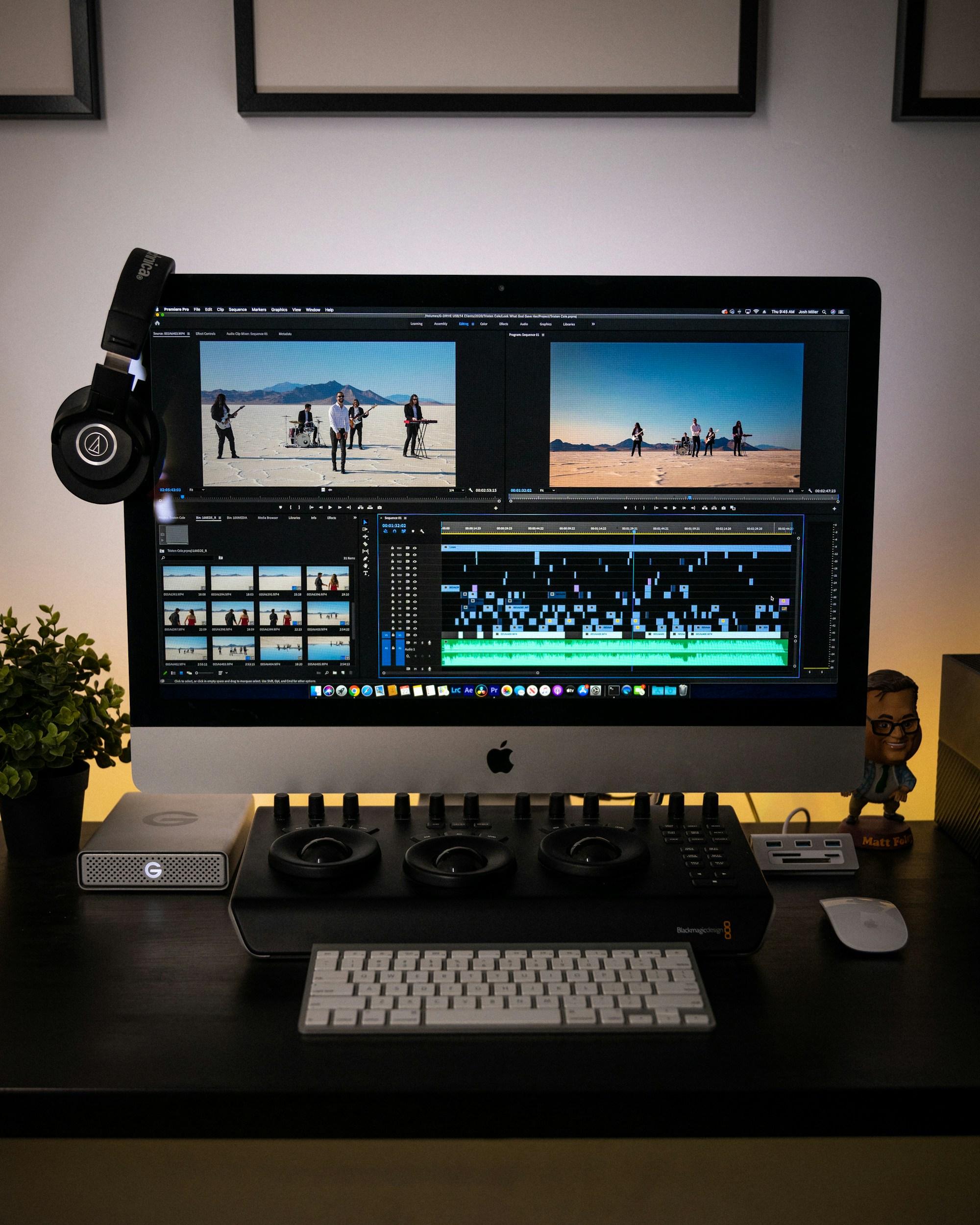
Finally, return to the timeline. Compare alternative assemblies, reshape the rhythm, listen for the moment that needs silence, and remove effects that weaken the scene. Review captions, continuity, sound, framing, and the final export. The point is to spend the time saved on decisions that make the film worth watching.
A faster pipeline is useful. A pipeline with no point of view simply produces repetition faster.
The Rise of Template Culture
Short-form platforms reward recognizable patterns. AI systems make those patterns inexpensive to replicate. The result is an expanding supply of technically polished but creatively interchangeable videos. Identical hooks, identical beat drops, identical captions, and identical motion graphics may optimize throughput while narrowing the visual imagination.
There is nothing inherently wrong with templates for practical communication. The problem begins when efficiency becomes the industry's definition of creativity.

Millions of Views Do Not Equal Artistic Achievement
A viral video can be entertaining, useful, or commercially successful. But virality alone cannot tell us whether it is original, emotionally effective, or cinematically accomplished. Metrics measure a particular audience response within a platform's distribution system. They do not replace criticism, taste, or artistic intent.
Editing Is Thinking, Not Just Cutting
Editing is the construction of time, tension, perspective, and emotional continuity. The same footage can become suspenseful, intimate, absurd, or tragic depending on the editor's choices. A cut can reveal information or conceal it. A pause can be more powerful than a transition. These decisions belong to storytelling, not merely software operation.
AI Could Create New Visual Languages
The irony is that generative technology offers extraordinary opportunities for experimentation. Filmmakers can explore impossible environments, unconventional transitions, nonlinear memory, altered perspectives, and images that would once have required enormous budgets. AI can expand the visual vocabulary of cinema when guided by a coherent creative vision.
The most exciting question is not how many videos can be generated in an hour. It is what images, rhythms, and narrative forms become possible that were previously beyond reach.
The Business of Declaring Editing Dead
Claims that an entire craft is dead are also effective marketing. They attract attention, create urgency, and can help sell subscriptions, affiliate products, and courses. That does not make every demonstration dishonest, but it is a reason to separate promotional claims from evidence. Ask what the tool actually performed, what a human contributed, and what the final work achieves beyond production speed.
The Future Belongs to Creative Judgment
I welcome tools that reduce repetitive labor and make ambitious filmmaking accessible. I reject the idea that faster, cheaper, and more numerous automatically means better. An editor's value is not simply the number of operations performed in a timeline. It is the ability to make those operations mean something.
If AI saves ten hours of repetitive work and those hours become a stronger story, that is progress. If AI lets an independent filmmaker realize a vision that once required a huge budget, that is progress. But if the ambition is only to generate thousands of near-identical videos faster, we have not revolutionized creativity. We have industrialized repetition.
Editing is not dead. Creativity is not a template. And cinema is more than content.
References
Original X response by Armstrong Clarke: https://x.com/clarkkarmstrong/status/2112019177955356991
BKFILM: https://www.bkfilm.net/












Comments