Making Boiling Point: Building a Film with AI, One Shot at a Time
Updated: 2 days ago
From screenplay and visual references to generated footage, editing, music and sound: a look at the filmmaking process behind BKFILM’s border thriller.

A frame extracted from a Boiling Point video source.
An empty road stretches toward the horizon. A car moves through the heat. Somewhere beyond the frame, a decision has already been made—and its consequences are beginning to reach the people caught inside the story.
That is the world of Boiling Point, a crime thriller set around the US–Mexico border. It follows Marisol Vega, DEA agent Tom Reyes and the people whose lives are pulled together by an arrangement that has been operating for years. The film moves between present-day events and earlier moments, using time, memory and the gradual release of information to build tension.
The film was written and directed by Bahadır Karasu. Its production combines filmmaking decisions with generative tools: Grok was used for visual creation; Suno for music; ElevenLabs for sound design; and CapCut for editing. The result is assembled through a process of developing references, creating and reviewing material, choosing shots and shaping them into scenes.
This article looks at that process through footage and production material from the project. The film stills shown here were extracted from source videos. The storyboard illustrates the pre-production approach to visualising shots; the editing-interface visual is a conceptual representation of the edit.
The workflow at a glance
Story and screenplay → visual development → shot references → generated footage → selection and editing → music and sound design → titles, colour and finishing.

A simplified overview of the stages; the process moves back and forth as material is reviewed.
These stages overlap. An edit can reveal that a scene needs a different angle; a new angle can make a previous reference worth revisiting. The process moves between planning and discovery as the film takes shape.

Source-video frame: Herrera Logistics establishes one of the locations around which the story unfolds.
Starting with the story
Before deciding how an image should look, the film needs a reason for that image to exist. Who is in the scene? What do they know? What should the audience understand now, and what should remain uncertain?
In Boiling Point, those questions matter because the story is not told as a simple sequence of events. An interrogation provides a frame for the narrative, while earlier events give context to relationships and decisions that become more complicated as the film progresses. The screenplay establishes the characters, the stakes and the order in which the audience encounters information.
The visual work begins from those dramatic needs. A room can feel controlled or threatening depending on where the camera sits. A close-up can bring us into a character’s uncertainty; a wider frame can show the distance between two people. A desert road can establish geography, but it can also hold a sense of isolation. The production process translates those narrative intentions into images that can eventually be edited together.

Source-video frame: the interrogation setting gives the story a controlled, restrained visual space.
Designing a consistent world
An AI-generated image can create a setting quickly, but a film asks for more than a single successful frame. The audience needs to believe that a character remains the same person from one shot to the next, that a room continues beyond the edge of the frame, and that different scenes belong to the same visual world.
For Boiling Point, that meant working with recurring character appearances, environments and visual references. The project contains close-ups, wider shots, two-person compositions and multiple versions of scenes. Looking at them together makes it possible to compare faces, wardrobe, lighting, framing and the relationship between a subject and the background.
The film’s locations offer distinct visual moods. The bright desert road creates a sense of exposure and distance. Offices and warehouses suggest systems and routines operating behind the story. The interrogation room strips the setting back to faces, gestures and the space between people. Night scenes introduce darker blues, warm practical lighting and more saturated colour.

Source-video frame: a house at night establishes the location for a tense sequence.

Source-video frame: a close-up brings the viewer into Marisol’s perspective.

Source-video frame: colour and lighting shift with the environment.
Continuity does not mean that every shot looks identical. It means the differences feel intentional: a change of distance, angle or light should support the scene rather than make the viewer question whether it belongs to the same sequence. That is where selection and revision become central to the process.
Heat as a visual clock
In Boiling Point, heat is more than a setting. As the story progresses and the pressure around the characters grows, the temperature makes itself felt on their bodies. Sweat, damp hair, tired expressions and the discomfort of the environment become part of the film’s visual language. The characters appear increasingly exposed to the heat as the narrative approaches its own boiling point.
This progression gives the title a physical presence. Tension is carried not only by what the characters say or the danger around them, but also by what the camera can observe: moisture on skin, a shirt clinging to the body, or the effort it takes to hold a composed expression. The audience can feel the atmosphere tightening even in a quiet close-up.

Source-video frame: physical discomfort becomes visible as the pressure rises.

Source-video frame: heat and tension register in the face and on the skin.
Against that rising pressure, the image of a ceiling fan introduces a different rhythm. Its steady rotation suggests an attempt to cool the room and briefly soften the tension. The contrast is subtle: a familiar object promises relief while the wider story continues to grow more intense. A small visual detail can therefore carry part of the atmosphere without needing a line of dialogue to explain it.
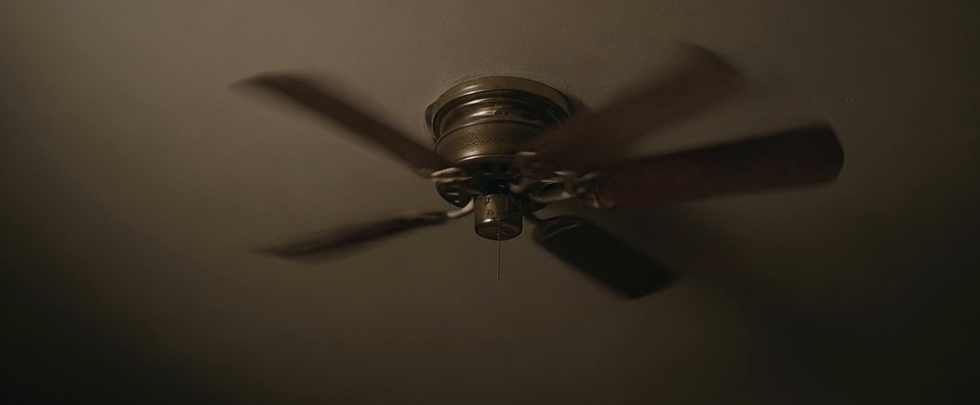
Source-video frame: the fan offers a visual counterpoint to the accumulating heat.

Source-video frame: the environment remains present in ordinary gestures and interior spaces.
From reference to shot
The visual development stage gives a shot a direction before it enters the timeline. References can establish a character’s appearance, the geography of a room, the position of a camera or the atmosphere of an environment. A reference is a starting point for choices, not a substitute for choosing how the shot will function in the film.
Grok was part of the image and video creation process for Boiling Point. The project contains short video clips and alternate versions that can be reviewed as potential coverage: an establishing shot, a closer view, a reaction or a detail. A scene can be built from multiple pieces of material, each serving a different purpose.

Source-video frame: a two-person composition gives both characters space within the scene.

Source-video frame: closer coverage changes the emphasis from space to expression.
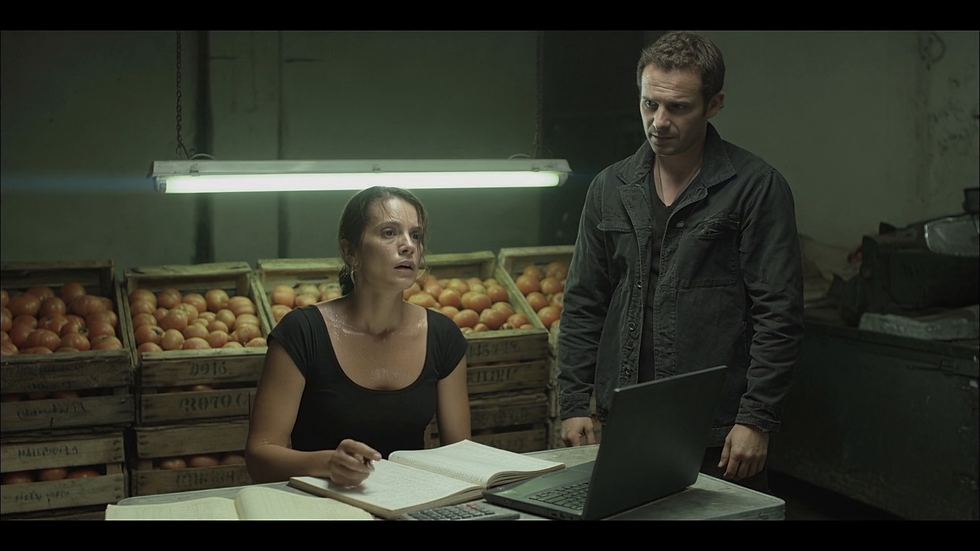
Source-video frame: a wider composition establishes the space between characters.
This is also where generated footage has to be evaluated as footage. Does the movement work? Does the character’s eyeline make sense? Can the end of one shot lead into the beginning of another? Is the moment long enough for a reaction, or does it end before the scene has made its point? These questions belong to editing as much as they belong to image creation.
Storyboarding a sequence
Action and spatial continuity make the need for planning especially visible. A raid scene, for example, contains several connected questions: where the team is, what it can see, which direction it moves and how the viewer understands the transition from outside to inside. The project includes storyboard development for a DEA raid and a helmet-camera perspective associated with Marcus Hale.
The production archive shows revisions to individual reference frames: agents waiting at a closed door, a wider view of their entrance and an interior view through the helmet-camera perspective. Those revisions illustrate how specific the work can become. A door’s state, the visibility of a weapon, the position of an agent or the amount of the body inside the frame all affect how one shot can connect to another.
The storyboard below offers an example of how the film’s shots can be visualised during pre-production: compositions, camera distance and the relationship between subjects are explored before the sequence is assembled. This illustration is a reconstruction based on selected film frames.

Pre-production storyboard example, reconstructed from selected source-video frames.

Source-video frame: a tactical sequence combines characters, movement, light and spatial continuity.
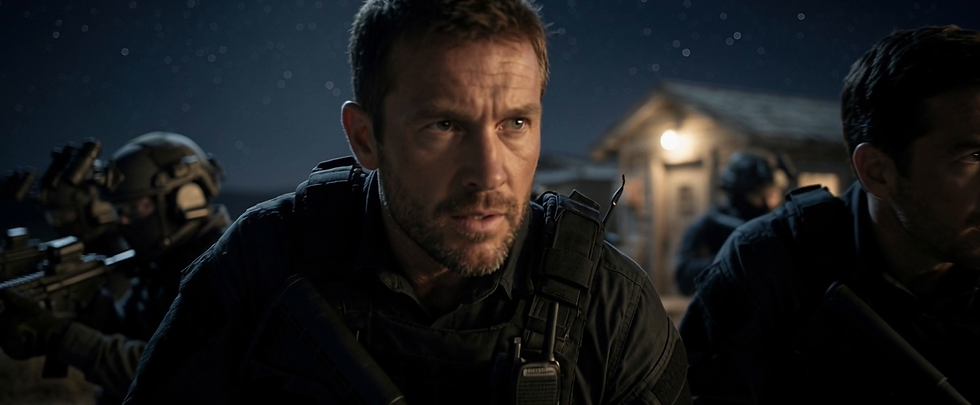
Source-video frame: a close reaction shot brings the tension of the night operation into the character’s expression.

Source-video frame: equipment and perspective help establish the point of view of an operation.
Creating coverage and managing alternatives
A scene rarely depends on one image alone. A wide shot can orient the audience; a close-up can focus attention; a reaction can make a line land. The editor needs enough material to create a rhythm between these views without repeating information unnecessarily.
The project’s video folders contain multiple versions and short clips. Some are alternate takes of similar dialogue or compositions. In one Spanish-language dialogue sequence, the lines were transcribed locally to help identify their meaning and arrange the clips in a coherent order. Repeated lines were marked as alternatives rather than treated as consecutive dialogue.
That example shows a practical side of AI filmmaking: organisation matters. A folder of clips becomes more useful when the filmmaker can see what each file contains, which version overlaps with another and what role it may play in a scene. A transcription tool can assist with that review, but it does not decide which performance or cut is best.

Source-video frame: dialogue scenes depend on expression, shot duration and the relationship between angles.

Source-video frame: a detail shot can provide a visual pause or direct attention to an object.

Source-video frame: a dialogue scene can play through movement within a composition.
Editing: where separate clips become a film
The main Boiling Point edit is in CapCut. The timeline brings together footage, sound layers and graphics so that scenes can be judged in context. A shot that looks strong on its own may feel too long beside another; a quiet reaction may become more valuable once the preceding line is in place.
Editing is the point at which the relationship between shots becomes visible. The cut determines when the audience sees a face, when it leaves a room, and whether a piece of information arrives before or after a reaction. It also determines how a scene breathes: whether a pause is allowed to remain, or whether the story moves on immediately.
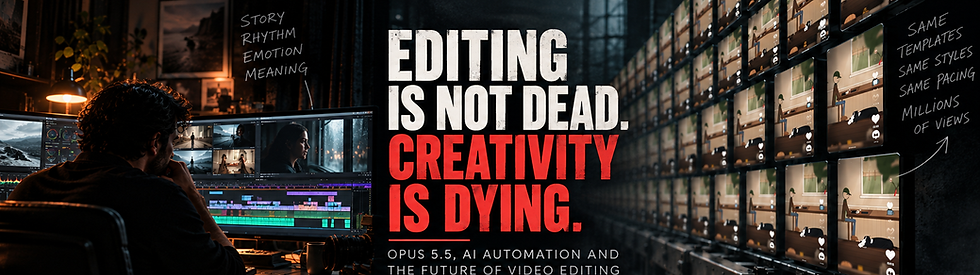
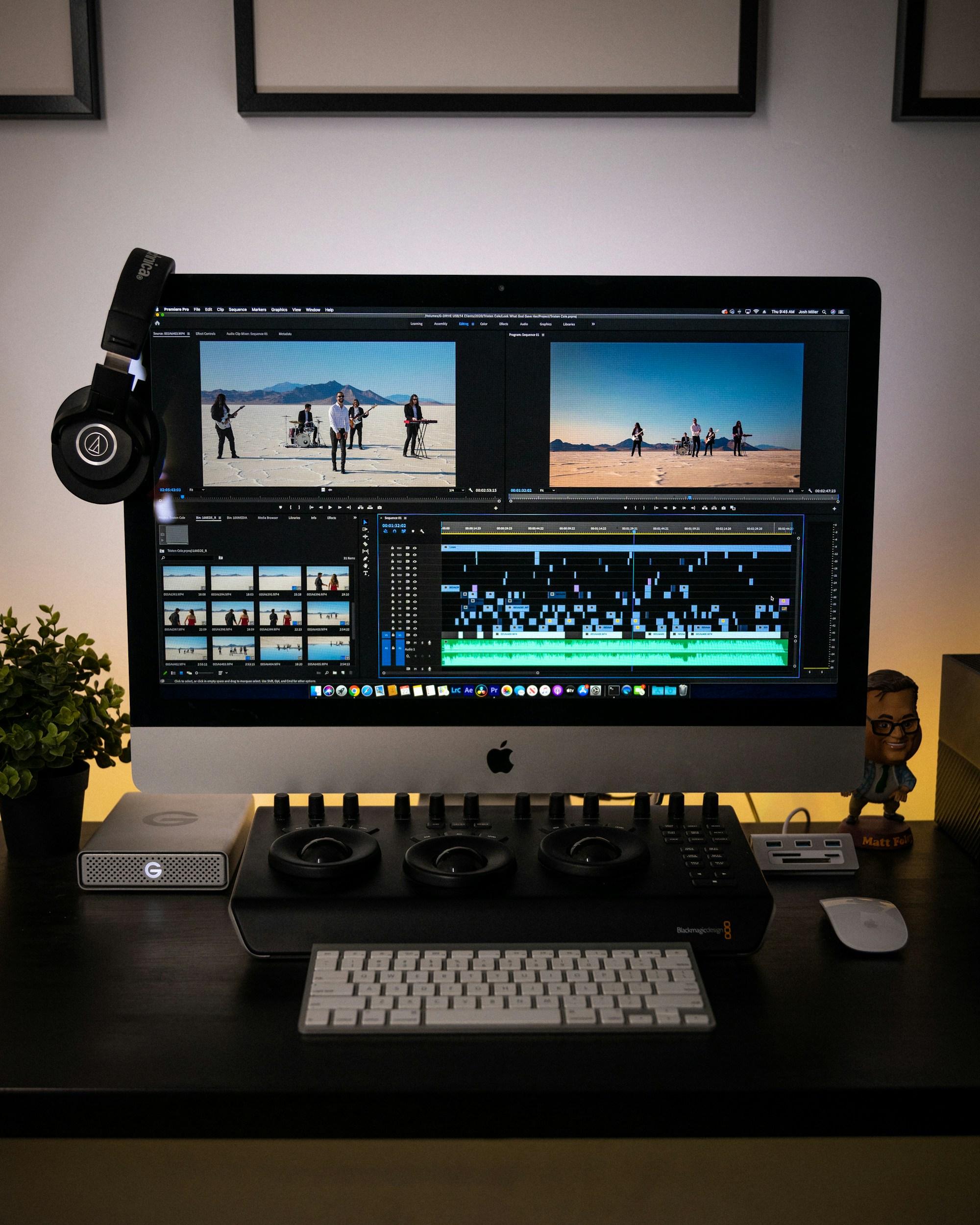
Bahadır Karasu is responsible for editing and colour work on the project. Generated footage provides material to work with; the timeline is where that material is selected, arranged and refined into a film. The illustration below is a conceptual editing interface made for this article, not a capture of the actual project.

Illustrative editing-interface concept; not an actual CapCut screenshot.

Source-video frame: a wider angle can establish the relationships that later close-ups explore.

Source-video frame: an office scene gives the edit another relationship to establish through coverage.
Music, sound and the sense of place
An image tells us what a location looks like. Sound can suggest what surrounds it: the presence of a road, a room’s atmosphere, the weight of a pause or the emotional direction of a transition. Music can give a sequence momentum, hold back to leave space for dialogue, or connect moments that are visually different.
For Boiling Point, Suno is credited as a music-creation tool and ElevenLabs as a sound-design tool. The project also contains audio material and sound layers in the edit. The creative work is in deciding how those elements support the scene: when music should enter, which details need attention and when the absence of an added sound may be more effective.
The precise source of every voice and sound in the film has not been documented in the material reviewed for this article. Those details should be confirmed before making a complete production-credit breakdown.

Source-video frame: a night exterior invites its own combination of movement, atmosphere and sound.

Source-video frame: everyday spaces contrast with the story’s more overtly threatening settings.
Titles, time and geography
Because the story moves between periods and locations, text can help orient the audience without interrupting the film’s visual language. The project includes location and time cards prepared as transparent 4K PNGs, along with title and credit assets. Their use belongs to the edit: a card has to arrive at the right moment, remain readable and then give the scene room to continue.
The chosen title treatment gives BOILING POINT prominence, with PUNTO DE EBULLICIÓN accompanying it. Location and time choices are part of the narrative as well as the design; they affect how viewers understand the relationship between scenes.

Source-video frame: the film’s visual language also makes room for quieter moments.
The human role in an AI-assisted workflow
The tools in this process do different jobs. The screenplay establishes the story. Visual generation produces possibilities for scenes and shots. Storyboarding tests how a sequence might be covered. Editing turns individual pieces into relationships. Music and sound add atmosphere and emotional direction.
Across those stages, the director and editor make choices: what to ask for, what to keep, what to revise, where to cut and how to make one image meaningful beside the next. Those decisions are not fully visible in a finished frame, but they shape how the film is experienced.
Boiling Point is a work in which generative tools form part of a wider filmmaking practice. Its process is built around the same questions that guide any screen story: whose perspective are we following, what are we asking the audience to notice, and what should a moment feel like when it ends?
Source-video frame: the road is one of the recurring visual spaces in the project.
Production notes: This article is based on the project’s screenplay, local production notes, source videos and the observed CapCut project. Film stills are frames extracted from local video files. The illustrated storyboard is a reconstruction demonstrating the pre-production approach; the editing interface is a conceptual representation rather than an actual screenshot. The production is in progress, and descriptions can be updated as credits and final creative decisions are confirmed.








Comments